Demand for local AI hardware is moving beyond Silicon Valley. Businesses in Russia, the Middle East, Southeast Asia, and Latin America increasingly want to run AI models on their own premises — for data privacy, for low latency, and because cloud access is not always reliable or affordable. China is where most of this hardware is built. This guide is for B2B buyers who want to source AI-capable mini PCs intelligently.
First, size the memory to the model
The most common sourcing mistake is buying for the wrong model size. Memory capacity is the gating factor: if a model does not fit, no amount of processor speed helps. Use this as a rough guide for 4-bit quantized models.
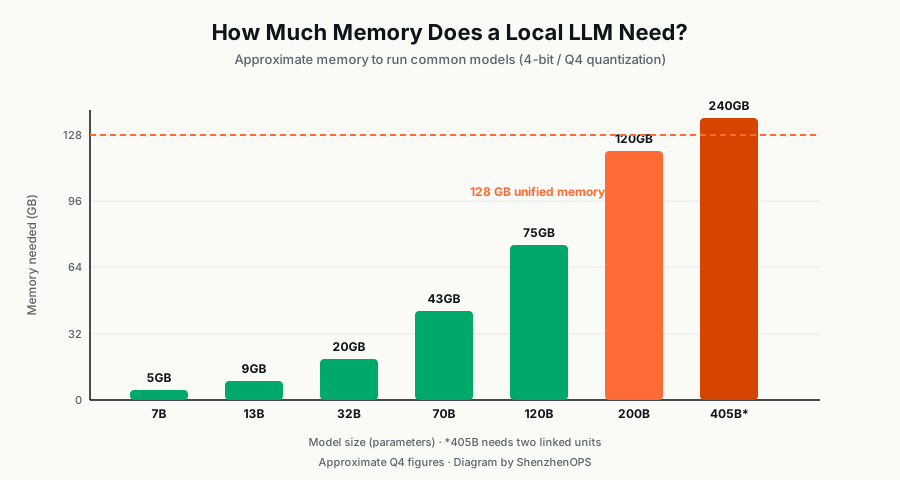
For most business workloads — assistants, document analysis, retrieval-augmented generation — a 7B to 70B model is the sweet spot, and a 128 GB unified-memory host handles those with room to spare.
Understand the three sourcing tiers
The market splits into three clear tiers, and knowing which you are buying from prevents overpaying or under-speccing.
- Premium (NVIDIA DGX Spark): $3,999+. Best software ecosystem, turnkey. Source this when CUDA compatibility is non-negotiable.
- Value (AMD Strix Halo boxes): $1,499–3,299. Most memory per dollar. A crowded field of capable vendors. Source this for general local-AI deployment.
- Domestic-chip / sovereign: variable. Lower peak performance and a younger software stack, but supply stability and local-compliance advantages. Source this when those factors outweigh raw speed.
What separates a good supplier from a risky one
Hardware is easy to copy; reliability is not. When you evaluate a Chinese manufacturer for AI mini hosts, weight these heavily:
- Thermal engineering. These chips draw 65–240W in a tiny chassis. Cooling quality is the difference between sustained performance and constant throttling. Ask for sustained-load benchmarks, not burst numbers.
- Memory quality and warranty. Unified memory is soldered and cannot be replaced by the user. Insist on new, specified-grade memory and a clear warranty — this is not a place for recycled components.
- Software support. Does the unit ship with a working local-AI stack (model runner, drivers) or just bare hardware? Out-of-the-box usability has real value.
- Certification for your market. CE, FCC, EAC, and local power standards matter for customs clearance and liability. Confirm before you order.
- White-label and ODM terms. If you are reselling under your own brand, confirm minimum order quantities, NDA terms, and customisation scope up front.
Why source from China — and what to watch
China, and Shenzhen specifically, has the world's deepest concentration of integration capability, flexible manufacturing, and supply chain. That is a genuine advantage: faster iteration, competitive pricing, and ODM flexibility that few other regions match. The watch-outs are the ones above — thermal honesty, memory quality, and certification. A supplier who answers those questions directly is one worth trusting.
Where this is heading
We expect AI-capable mini hosts to follow the same path OPS modules did: expensive and niche at first, then standardised and affordable as more silicon enters the market. Buyers who learn the architecture now will source far better in two years. If you are building a position in this category — for your own deployment or as a product line for your market — we are glad to share what we see from the manufacturing side.