Two platforms dominate the conversation around local AI hardware in 2026: NVIDIA's DGX Spark and AMD's Strix Halo (Ryzen AI Max+ 395). They target the same goal — running large models on a desk — but they are built for different buyers. As a manufacturer that works with both ecosystems, here is an honest comparison aimed at businesses deciding what to source.
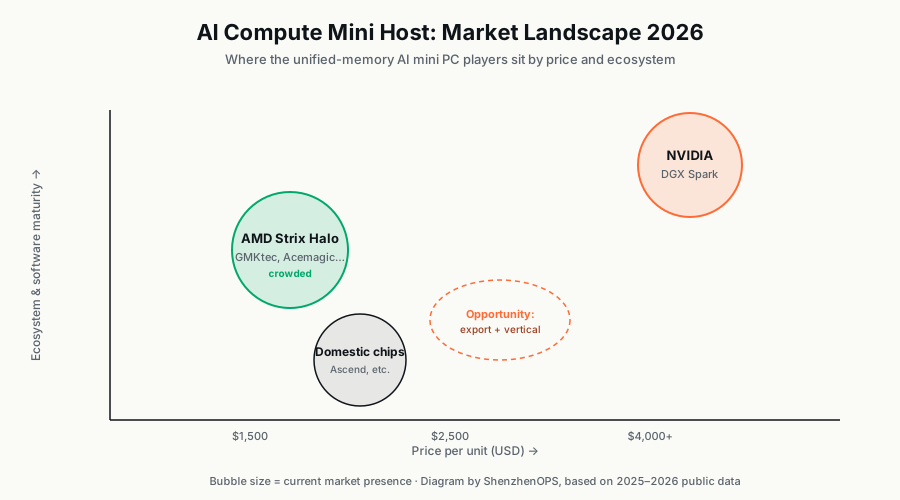
The quick verdict
If your stack depends on CUDA-native tooling and you value a turnkey, fully-supported appliance, DGX Spark is built for you — at a premium. If you want the most unified memory per dollar and can work within the AMD ROCm ecosystem, a Strix Halo mini PC delivers most of the capability for roughly half the price.
NVIDIA DGX Spark
Launched in October 2025 at a $3,999 list price ($4,699 for the top configuration), the DGX Spark is built around the GB10 Grace Blackwell Superchip: 20 ARM cores, a Blackwell GPU delivering up to 1 petaFLOP at FP4, and 128 GB of unified LPDDR5X memory at 273 GB/s. It runs models up to 200 billion parameters locally, and two units can be linked to handle 405B.
Its real advantage is the software. The full NVIDIA stack — CUDA, TensorRT, NeMo, vLLM — runs natively. For teams that prototype locally and deploy to NVIDIA data-center hardware, the code ports directly. You are paying for an integration tax that someone else has already paid.
AMD Strix Halo (Ryzen AI Max+ 395)
Strix Halo takes the value position. The chip pairs 16 Zen 5 cores with a 40-CU RDNA 3.5 integrated GPU and an XDNA 2 NPU (50 TOPS, 126 TOPS total), with up to 128 GB of unified LPDDR5X at around 256 GB/s, in a 65–120W mini PC. It runs Llama 3.1 70B in BF16 entirely on the integrated GPU — something no consumer discrete card can do.
Crucially, the ecosystem of boxes is already large and competitive. Vendors are shipping 128 GB Strix Halo mini PCs from roughly $1,499 (GMKtec EVO-X2) up through $2,499–3,299 (Acemagic Tank M1A Pro+). AMD's own first-party Ryzen AI Halo mini PC arrives mid-2026 at $3,999. The trade-off is software maturity: ROCm has improved but still trails CUDA in breadth of supported tools.
The shared limitation
Both platforms live within the same physics: unified memory bandwidth (256–273 GB/s) is far below discrete VRAM. Both can load very large models thanks to 128 GB capacity, but token-generation speed is bandwidth-limited. For interactive assistants, document processing, and agentic workflows this is fine. For high-throughput production serving, plan accordingly.
Which should a business choose?
- Choose DGX Spark if: you need CUDA-native tooling, you deploy to NVIDIA infrastructure, or you want a fully-supported appliance and budget is secondary.
- Choose Strix Halo if: you want maximum memory per dollar, you run inference (not training), and you are comfortable with the AMD/open-source software path.
- Consider a domestic-chip option if: you operate in a market where supply stability, local compliance, or sovereignty outweigh peak performance.
We help buyers match the platform to the use case and the destination market — including export markets where neither incumbent has strong local support. If you are weighing options for a deployment or a product line, reach out and we will give you a straight assessment.