At Computex and Microsoft Build in June 2026, NVIDIA unveiled RTX Spark — a new superchip built to run AI agents and large models directly on the PC — and Jensen Huang framed it as the first true reinvention of the personal computer in four decades. Microsoft, Dell, HP, ASUS, Lenovo and others lined up behind it. The vision on stage was vivid: an AI supercomputer in every home, as ordinary as a dishwasher.
That vision will sell a lot of premium laptops. But for businesses, integrators, and procurement teams in markets like Russia, the Gulf, Southeast Asia, and Latin America, the more useful question is quieter: what does this reset actually change about how we should source AI hardware over the next two to three years? This article is a manufacturer's-eye view of that question.
The real story is a replacement wave
When the largest chip and software companies in the world jointly declare a new category and back it with a multi-year chip roadmap, the practical consequence is predictable: the global installed base of "pre-AI" computers starts aging out. Over the coming years, a large share of business and consumer machines will be replaced by hardware that can run AI on-device. That is a multi-year demand cycle, not a single product launch.
For anyone in the sourcing and reselling business, replacement waves are where the volume is. The opportunity is not to compete with NVIDIA on a flagship laptop — it is to supply the long tail of buyers and use cases the flagship launches do not serve.
Where the consumer launches leave a gap
The headline AI PCs are consumer and creator laptops: sleek, premium, single-user, cloud-and-brand-tied. They are excellent at what they are for. But a great deal of real-world AI demand looks nothing like that:
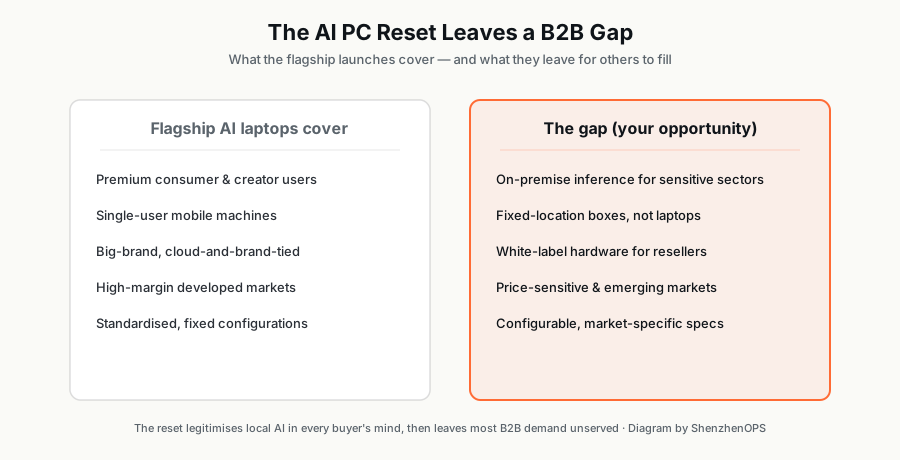
- On-premise inference for sensitive sectors — finance, healthcare, government, and any organisation that cannot send data to a cloud needs a box that runs models inside its own walls.
- Fixed-location compute — a unit that lives in an office, a branch, a clinic, or a kiosk and serves a team or a workflow, not a single laptop user.
- White-label hardware for resellers — system integrators who want to sell AI compute under their own brand, in their own market, with their own support.
- Markets the flagship supply chain underserves — price-sensitive regions, or markets where export-controlled silicon is impractical and an alternative platform is required.
This is the gap. The AI PC reset legitimises local AI in every buyer's mind — and then leaves most of the B2B and emerging-market demand for someone else to fill.
What to actually look for when sourcing
If you are buying or reselling local AI hardware in this new landscape, the fundamentals matter more than the marketing:
1. Size memory to the model, not the hype
Memory capacity decides which models you can run at all. A unified-memory design — one large shared pool the whole model can sit in — is what makes a small device able to load a large model. Match the memory to the largest model your use case needs, with headroom; do not overpay for compute you cannot feed.
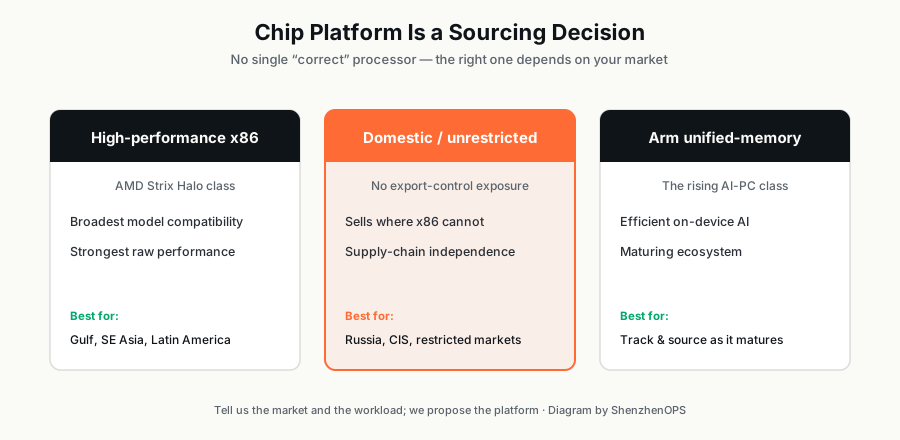
2. Treat the chip as a sourcing decision, not a religion
There is no single correct processor. High-performance x86 platforms offer the broadest model compatibility for compliant markets. Arm-based unified-memory chips are the rising AI-PC class. And for markets where export-controlled silicon is impractical, domestic and unrestricted-supply platforms are often the only way to actually deliver. The right answer depends on your market and compliance situation — which is exactly why a flexible supplier beats a single-vendor one.
3. Vet thermals, memory quality, and certification
Always-on AI inference is a sustained thermal load, not a burst. Cooling design, memory grade, and the certifications your market requires (CE, FCC, EAC, and local marks) separate a unit that survives 24/7 duty from one that throttles or fails in the field.
The sourcing-agent advantage. In a moment of rapid platform change, the worst position is to be locked to one product or one chip. A Shenzhen / Pearl River Delta sourcing partner can move with the market — propose the platform that fits your compliance and budget today, and adjust as the roadmap evolves. The deep electronics ecosystem here means "which chip, which spec, which volume" is a conversation, not a constraint.
Where ShenzhenOPS fits
We build the B2B box the flagship launches skip: a compact, on-premise AI Compute Mini Host designed to run local models, white-labelable for resellers, and sourced on the platform that fits your market. It extends our SZO product family — already shipping OPS modules, mini PCs, and industrial systems — into the local-AI era.
If you are positioning for the AI PC reset in your market, the time to shape the spec is before it is frozen. Tell us your market, your workload, and your compliance constraints, and we will propose a platform and a path — and if your needs run beyond AI hardware into the wider world of electronics and components, that is squarely what we do.
Talk to us early — about the AI Compute Mini Host, or any electronics and components your projects need.
Start a conversation →